Why Science Fiction?
Writing Science Fiction: Why Science Fiction? Or What drew me to sci fi?
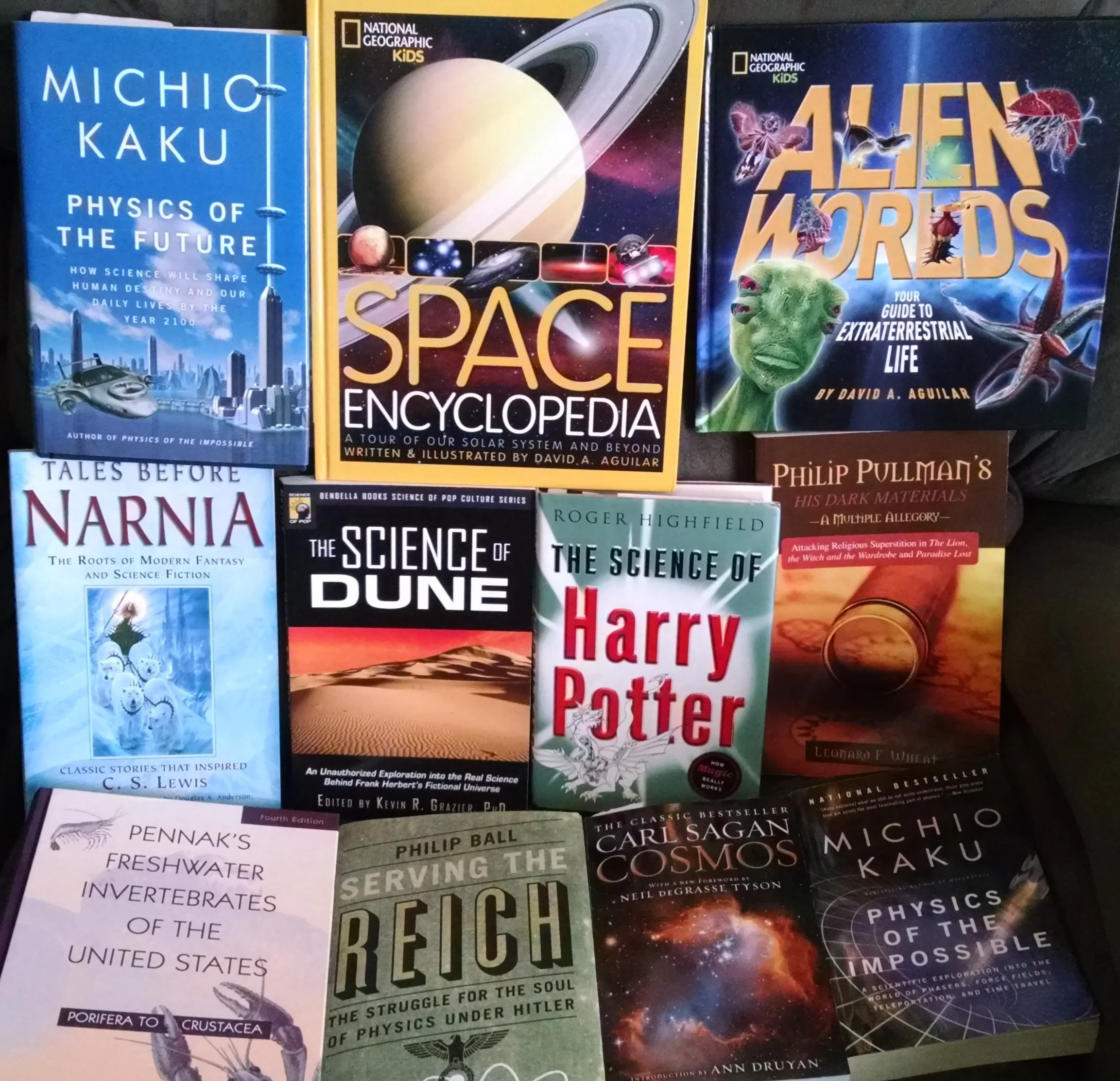
Some books from my library
Ever since second grade when Mrs. Tolliver would spend a short period of time each week showing us a cool science trick like drawing an egg into a bottle using heat, I knew that I was meant to be a scientist. During second grade, I made my dad buy me my first science book from our favorite book store: Pic-A-Book in Spartanburg, S.C. I still have the book today: The World of Stars and Planets: over 80 full-color pictures in dictionary form for easy reference published in 1968 by B.P.C. Publishing Limited. It was marked down to 85 cents from $2.95. Of course it’s hopelessly out of date today. For instance, Pluto was still a planet, but that was the start of me expanding my knowledge about science. The first science fiction book I read was The Wonderful Flight to the Mushroom Planet by Eleanor Cameron first published in 1954 by Little, Brown and Company. I remember discovering the book in my elementary school library during third grade. The library was brand new then and so much larger than the old library that was in a cramped closet-like space. I almost remember exactly where I found the book, about eye level to me in the left back corner of the library. I remember being drawn in by the strange scientist who weighed hardly anything and was able to entice two boys to build a spaceship to travel to a nearby planet. I remember how lucky it was that the chicken they brought with them helped solve a crises faced by the strange inhabitants of Planet Basidium. Ever since then, I’ve not been able to read enough science fiction.
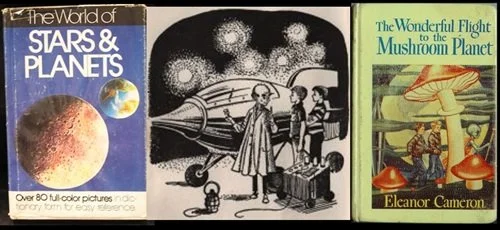
Books I read when I was in elementary school
And what is the appeal of science fiction? It’s all about plausible transport into a world of wonder and possibilities (Farland 2013). Science fiction has the best monsters, because they could be real and it’s important to know that monsters can be killed (Athans 2014). Science fiction has the best mysteries because one can explore the unknown (Star Trek TV series). Science fiction has the best characters because it isn’t restricted to Homo sapiens (e.g. Russell’s 1996 world that supports two sentient species). Science fiction can play with the laws of physics and burst into alternate realities and alternate worlds (Kaku 2008, 2011). Science fiction can take a haunting look into the direction of human evolution given novel environmental pressures (Wells 1895 The Time Machine where humans have fractured into an at first appealing childlike aboveground variant and a belowground predator). Science fiction can be a warning to us about our future path (e.g. the lunar revolt aided by a sentient computer named Mike Heinlein’s Moon is a Harsh Mistress and a fireman who begins to question why he must burn books in Bradbury’s 1953 Fahrenheit 451 book). And science fiction can establish novel political structures that make characters face life and death situations (Herbert’s Dune series starting with the first book published in 1965 where spice, an intergalactic must need commodity, is made by a ginormous and dangerous sandworm which the native Fremen have learned to harness to travel throughout their desert world).
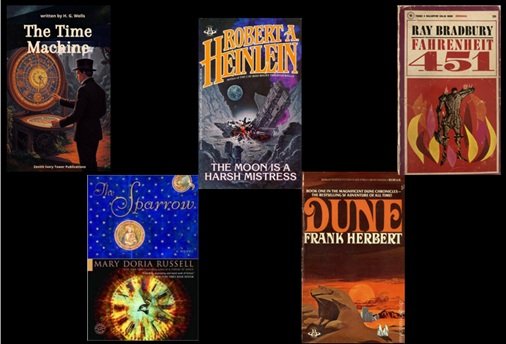
Select Science Fiction Books
When asked why write, Ray Bradbury said it best “Stay drunk on writing so that reality doesn’t destroy you.” Ray Bradbury was one of the all time best science fiction writers in the 20th Century. Many of The Twilight Zone episodes were written by him. I think what Bradbury means is that writing about science fiction is writing about the hope that humans can do better.
What do you think? Do you think science fiction can help humans do better? Lead to a more hopeful future? Do you find reading or writing to be a good escape from reality? What draws you to read or write science fiction? What was the first science fiction book you read and when?
Literature Cited:
Athans, Philip. 2014. Writing Monsters. Writer’s Digest Books. Cincinnatti, Ohio.
Bradbury, Ray. 1953. Fahrenheit 451. Ballentine Books. New York.
Eleanor Cameron. 1954. The Wonderful Flight to the Mushroom Planet. Little, Brown and Company. Boston, Massachusetts.
Farland, David. 2013. Million Dollar Outlines 2013 Edition. Self published
Heinlein, Robert A. 1966. The Moon is a Harsh Mistress. G. P. Putnam’s Sons. New York, New York.
Herbert, Frank. 1984 edition. Dune. Berkeley Books. New York.
Kaku, Michio. 2008. Physics of the Impossible: a Scientific Exploration Into the World of Phasers, Force Fields, Teleportation, and Time Travel. Anchor Books a Division of Random House, Inc. New York.
Kaku, Michio. 2011. Physics of the Future: How Science Will Shape Human Destiny and Our Daily Lives By the Year 2100. Doubleday. New York.
Russell, Mary Doria. 1996. The Sparrow. Villard Books. A Ballentine Book published by Random House Publishing Group. Kindle Edition.
Star Trek T.V. series
The Twilight Zone T.V. series
The World of Stars and Planets: over 80 full-color pictures in dictionary form for easy reference published in 1968 by B.P.C. Publishing Limited.
Wells, H. G. The Time Machine. 1895. Reprinted in The Complete Science Fiction Treasury of H. G. Wells. New York; Avenel Books, 1978.